Rednap Howell (ca. 1748 – December 1787)
Schoolmaster, Poet, and Bard of the Regulators
“I knew a very wise man that believed that if a man were permitted to make all the ballads, he need not care who should make the laws of a nation.” , Andrew Fletcher of Saltoun
Rednap Howell was a schoolmaster and poet who became one of the most effective voices of the North Carolina Regulator Movement, a grassroots uprising of frontier farmers against corrupt colonial officials that preceded the American Revolution by nearly a decade. He wrote ballads, petitions, and pamphlets that gave ordinary people words for their anger and made the powerful look ridiculous. The colonial governor called him an outlaw. History remembers him as a man who understood that a well-aimed verse can be as dangerous as a musket ball.
He was almost certainly a member of the same Howell family that produced Governor Richard Howell. The exact relationship is disputed in the sources, but the weight of the evidence suggests he was a brother of Ebenezer Howell, and thus an uncle of Richard. Both men were poets. Both were outlaws in their time. And remarkably, both died in Trenton, New Jersey.
Family Connection#
The question of Rednap’s relationship to Richard Howell has been debated since the nineteenth century. Some sources, including Appleton’s Encyclopaedia of American Biography, identify him as Richard’s brother. But the more carefully documented account, drawn from L. Q. C. Elmer’s Reminiscences of New Jersey and considered more authoritative by the New Jersey Historical Society, makes this unlikely on the basis of dates.
According to Elmer, Richard Howell was one of eleven children born to Ebenezer Howell, whose parents came from Wales around 1729 and settled in Newark, Delaware. Richard and his twin Lewis were born in 1754. If Rednap was in North Carolina by the late 1760s, already a young adult, he was almost certainly of an older generation. The most plausible conclusion, drawn by historian Samuel A. Ashe in his 1906 Biographical History of North Carolina, is that Rednap was Ebenezer’s brother, making him Richard’s uncle.
The family connection, whatever its precise degree, is not in doubt. The Welsh Howell line, the New Jersey associations, and the fact that Rednap returned to New Jersey and died in Trenton, the same city where Richard Howell would later serve as governor, all point to a shared family.
Source: Samuel A. Ashe, Biographical History of North Carolina from Colonial Times to Present, Vol. III (1906). L. Q. C. Elmer, Reminiscences of New Jersey. 5 American Ancestry, p. 191.
The Schoolmaster in the Backcountry#
Rednap Howell arrived in North Carolina as a young man, likely not yet twenty-one, and took up work as a schoolmaster, first in lower Orange County (now Chatham County), and by 1768 in what is now Randolph County. He was the kind of teacher that communities remembered. Historian William Few, describing a schoolmaster of this era, wrote:
“The schoolmaster was a man of mild and amiable disposition. He governed his little school with judgment and prosperity, wisely distinguishing the obedient, timid child from the obstinate and contumacious… He possessed the art of making his pupils fear, love and esteem him.”
Howell was genial, warm-hearted, and humorous. He worked alongside his patrons on their farms, helped in their households, took boys hunting, and by one account taught girls to dance to his own fiddle. His education set him apart, but his temperament drew him in. He was loved as much as admired.
The backcountry of Orange and Anson counties was home to small farmers, Scotch-Irish settlers, Quakers from Pennsylvania, and the overflow of poorer whites from Virginia. They had grievances: colonial officials who charged illegal fees, lawyers who exploited them in the courts, sheriffs who seized property for questionable debts. When these farmers began organizing as Regulators, demanding accountability and honest government, Rednap Howell made their cause his own.
The Regulator Movement#
The Regulator Movement emerged in the late 1760s as a challenge to the corruption of colonial officials in the North Carolina backcountry. The Regulators were not revolutionaries seeking independence, they were farmers demanding that the laws already on the books be fairly enforced. Their enemies were not the Crown but its local agents: sheriffs, clerks, and lawyers who lined their pockets at the expense of people who had no recourse.
Howell first appears in the historical record on April 30, 1768, appointed as one of the settlers to meet with officers at Thomas Lindley’s. He was soon at the center of the movement’s organizing work. On May 21, 1768, at a meeting at George Sally’s, he was appointed to a committee to prepare a formal statement of the Regulators’ grievances, a document to be presented to Governor Tryon himself.
Howell, working with James Hunter and John Lowe, drafted the petition. It was, in the words of a later historian, “a forcible presentation of the Regulator side of the controversy, strongly worded, well arranged and generally restrained in tone.” He and Hunter traveled to Brunswick to present it personally to the governor and council. Howell went further and made an oral argument.
It did not go smoothly. When Howell produced an agreement proposing that disputes be settled by arbitration rather than the corrupt courts, Governor Tryon flew into a rage and ordered him to burn it. Howell, by one account, complied. The governor’s reaction cemented Howell’s contempt for him, and sharpened his pen.
Source: 7 Colonial Records of North Carolina, pp. 731, 733, 758, 759, 802, 820, 851.
The Bard of the Movement#
Rednap Howell’s most enduring contribution to the Regulator cause was not his petitions but his poetry. He wrote approximately forty ballads, ambling epics and jingling songs that circulated among the settlers, lampooning the officials who preyed on them. Only three fragments survive.
The verses worked because they were memorable, shareable, and ruthlessly funny. They named names. Edmund Fanning, the register of deeds who grew wealthy through extortion, and John Frohock, the county official, became the targets of mockery that ordinary farmers could quote around their fires:
“Says Frohawk to Fanning, ‘To tell the plain truth, When I came to this country I was but a youth. My father sent for me, I wa’n’t worth a cross, And then my first study was to steal for a horse…’
“Says Fanning to Frohawk, ‘Tis folly to lie; I rode an old mare that was blind of an eye; Five shillings in money I had in my purse, My coat it was patched, but not much the worse; But now we’ve got rich, and it’s very well known That well do very well if they let us alone.”
Another fragment celebrated the moment the Regulators forced Fanning to wade the Eno River, humiliating the man who had been extorting them:
“At length their head man they sent out To save their town from fire; To see Ned Fanning wade Eno Brave boys, you’ll all admire.
With hat in hand, at our command To salute us every one, sir; And after that kept off his hat To salute old Hamilton, sir.”
These verses did something that petitions could not: they stripped the officials of their authority in the eyes of the people. The farmers of the backcountry faced men who dressed well, lived well, and carried the weight of colonial office. Howell made them look like thieves and fools. It was, as a later historian observed, “a more effective instrumentality to arouse the people to action than such verses could scarcely be found.”
The Hillsboro Riot (September 1770)#
The Regulator crisis came to a head in September 1770 at Hillsboro, when the Regulators disrupted the Superior Court, drove out the judges and lawyers, and administered public whippings to officials they considered corrupt. Rednap Howell was there and played a leading role.
He is said to have written the petition presented to Judge Henderson during the disruption. Under his influence, the Regulators treated the whole affair as grim theater, sparing Edmund Fanning’s life on the condition that he run until he was out of their sight. The violence was real, but it was also calibrated. One historian attributed this restraint directly to Howell’s influence: the poetry had shaped how the movement saw itself, and it saw itself as delivering rough justice, not bloodshed.
Outlawed#
The Regulator movement ended in military defeat. On May 16, 1771, at the Battle of Alamance, Governor Tryon led militia forces against a Regulator assembly. The farmers, poorly armed and overconfident, were routed. Nine were killed in the battle; six leaders were subsequently hanged.
Rednap Howell fought at Alamance. When the battle was lost, he fled, first to Maryland, then by late 1772 to Augusta County, Virginia. He was outlawed; a price was put on his head.
In 1775, as the colonies moved toward revolution, Governor Josiah Martin wrote to the Earl of Dartmouth recommending a general pardon for the former Regulators, with two exceptions. One was Herman Husbands. The other was Rednap Howell.
“I humbly advise my Lord the Pardon should be general with exception only of Hermon Husbands and Rednap Howell.” , Governor Josiah Martin to the Earl of Dartmouth, May 18, 1775
Even four years after Alamance, the colonial government considered Howell dangerous enough to exclude from amnesty.
Source: Letter from Governor Martin to the Earl of Dartmouth, May 18, 1775. North Carolina Colonial Records.
Return and Death#
At some point after the outbreak of the Revolution, Rednap Howell returned to New Jersey, the colony his family had helped settle. He died in Trenton in December 1787, the same city where his nephew Richard Howell would later serve as governor.
He died poor. His entire estate was inventoried at £7 17s. and 9 dimes. He is believed to have died unmarried and without children.
There is a quiet symmetry in the ending. Richard Howell died in Trenton in 1802, a celebrated governor. Rednap Howell died there fifteen years earlier, an outlaw who had been pardoned by no one, owning almost nothing. The same city, the same family, very different fates, and yet both men had spent their lives making the case, in their own ways, that the people deserved better from those who governed them.
North Carolina recognized his legacy with Historical Marker K-64, erected in his honor near the area where he lived and organized.
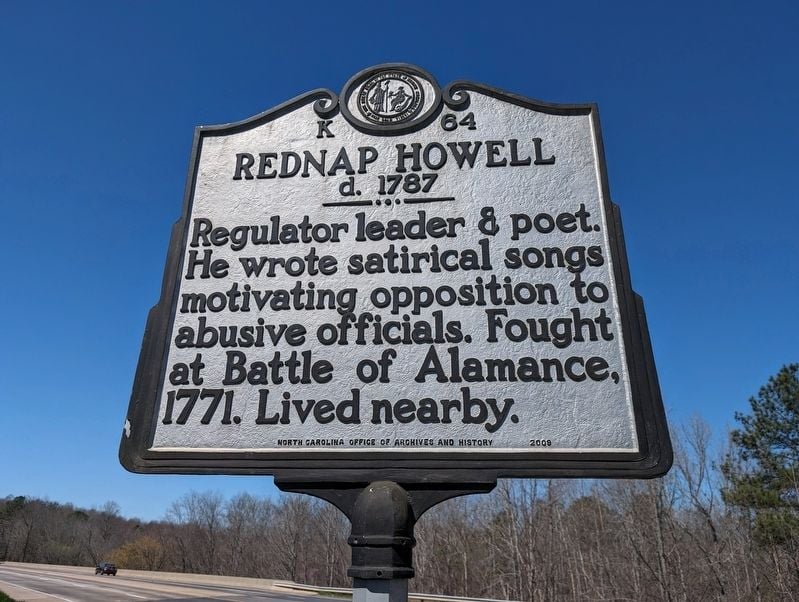
NC Historical Marker K-64, Randolph County, North Carolina. Photo: Mike Wintermantel, Pittsburgh, Pennsylvania (March 23, 2024).
Sources#
| Source | Details |
|---|---|
| Samuel A. Ashe | Biographical History of North Carolina from Colonial Times to Present, Vol. III (1906), primary narrative source |
| North Carolina Colonial Records | Vol. 7, pp. 731, 733, 758, 759, 802, 820, 851; Vol. 8, p. 537, documentary record of Regulator movement |
| Governor Martin to Earl of Dartmouth | May 18, 1775, exclusion from pardon |
| L. Q. C. Elmer | Reminiscences of New Jersey, family relationship evidence |
| NC Historical Marker K-64 | Rednap Howell, Hillsborough, North Carolina |
| 5 American Ancestry, p. 191 | Howell family genealogy |
Content licensed under Creative Commons Attribution-NonCommercial 4.0 by William Henderson.