The Howells of Wales and of the west of England are surrounded in the Cymric annals by legends as varied as those which compose the Nibelungenlied or the Arthurian circle. Amid the strains of martial music and the clang of arms in the wrestle for supremacy among the various Welsh tribes (temp. 900 et seq.) Howel Dda, or Howel the Good, stands out as the most famous of the early Welsh kings, and he is described in William of Malmesbury’s Chronicle as “King of all the Welsh.” The son of Cadell, the son of Rhodri the Great, his pedigree was traced by a tenth century genealogist to Cunedda, thence to Ann, cousin of the Blessed Virgin.* Howel succeeded his father circa 909, and, though subject to the lady of the Mercians, Æthelflæd, and her husband, Æthelred, as well as their successor, Edward the elder, became Lord of the North Welsh in 922, and King of the West Welsh in 926. He attested charters drawn in the reign of Athelstan as “Howel subregulus,” in the reign of Eadred as “Howel regulus,” and in 949 as “Howel rex.” He is styled by Simeon of Durham, a contemporary, “rex Brittonum.”
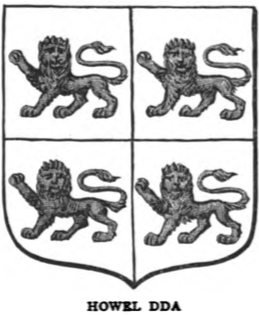
Stripped of legendary lineage and the interesting fictions of those stirring times, Howel’s best claim to remembrance is as a lawgiver, though the vast code of Welsh laws which is known as the Laws of Howel the Good survives only in manuscripts of a period much later than his own. Two Latin manuscripts, one of the twelfth century at Peniarth, the other of the thirteenth century at the British Museum, and a Welsh manuscript of the North Welsh Code, also at Peniarth, contain in their prefaces a full account of the circumstances under which the laws were framed. These set forth that Howel, observing that “the Welsh were perverting the laws,” summoned a kind of parliament to meet him during Lent, at the White House on the Taf, and that the members thereof critically examined the old laws, abrogated some, amended others, and enacted new ones. The altered code was then promulgated by Howel, and a curse pronounced upon all who should not obey its mandates, after which he, with the Archbishop of St. Davids, the bishops of St. Asaph and Bangor, and others specially appointed, made a pilgrimage to Rome, where the laws were laid before the pope, who also gave them his sanction. And from that time until the reign of Edward I. the laws of Howel the Good remained in force.
The Welsh traditional judgment on Howel, who died A.D. 950, was that he was “the chief and glory of the Britons,” that he loved peace, feared God, and governed conscientiously. He married Ellen, the daughter of Loumarc. They had four sons, the eldest of whom, Owain, succeeded his father.
Page 129
Among the many Welsh warriors of the Howel name whose triumphs and defeats ring down the ages, Sir Howel y Fwyall is one whom fact and fiction alike delight to honor. A descendant of Collwyn ap Tangno, the founder of the fifth noble tribe of North Wales, he inherited the martial genius of his sires, and fought with the Black Prince at Poictiers. He displayed such valor and did such execution with his pole-axe on this occasion that the prince created him a knight and “allowed a mess of meat to be served before his axe or partisan forever in perpetual memory of his good service,” which mess, after it had appeared before the knight, was carried away and bestowed upon the poor, and the said mess had eight yeoman attendants, who were afterwards called yeomen of the crown, found at the King’s charge, with eight pence a day standing wages.
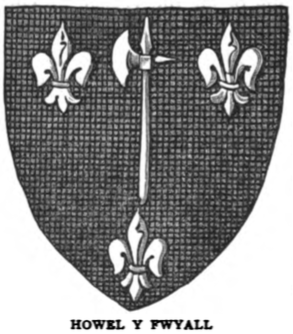
Howel was also made governor of the fortified castle Cricciaith by the Black Prince. His portrait and coat of arms were removed from their ancient home, Ystumllyn, to Broom Hall by Rowland Jones, Esq., who purchased the former estate in 1837.
Howel Sele, a descendant of Bleddyn ap Cynfyn, Prince of Powis, founder of the third royal tribe of Wales, was another Howel who made war the chief occupation of life. He was lord of Nannau in Merionethshire, now famous for the extent of its park, its height above the sea, and the beauty of its forest-trees. Not far from the manor-house stood until 1813 the famous oak called “Derwen Ceubren yr Ellyll” (“the demon’s hollow tree”), an object of superstitious fear and interest to the peasantry throughout Merionethshire.
Traditions vary as to the part borne by Howel in the terrible insurrection of Owain Glyndwr, his cousin, but agree that he was an adherent of the House of Lancaster, and that meeting Glyndwr and his attendant Madog in the park at Nannau, he was by them slain in 1401, and his body deposited in the trunk of the above-mentioned oak, where it remained forty years. After the death of Glyndwr, Madog fulfilled the dying commands of his warrior master, that the mystery attending the disappearance of Howel should be unveiled. He told his mournful story at Nannau, and an incision was made in the tree, when the skeleton of the murdered chieftain was disclosed grasping in the right hand a rusty sword. The remains were removed and interred in the neighboring abbey of Cymmer, and masses were sung for the repose of the troubled soul of the Lancastrian Howel Sele.
This tradition forms the theme of a fine ballad by the Reverend George Warrington, printed in the notes of Scott’s “Marmion.” Madog there tells the entire story, which is full of interest to the descendants of Howel Sele, many of whom are in Pennsylvania and elsewhere in America. The hollow oak is also the subject of a fine engraving, from a sketch by Sir R. Colt Hoare, Bart, made on the day the venerable tree fell, 13 July, 1813.
Military science was, however, not the only profession adopted by the Howells. History and genealogy had their representative in Howel Swrdwal, who flourished between 1430 and 1460, and who wrote a chronicle of Wales and a genealogy from Adam to Edward I., both in Latin.
Page 130
The church also had its adherents, and one descendant of Howel Dda, of the Howel name, the Right Reverend Thomas Howell, D.D., wore the episcopal vestment. He was the eldest son of the Reverend Thomas Howell, vicar of Llangammarch, Brecknockshire, and of Abernant in Carmarthenshire, and was born at Bryn, in the parish of Llangammarch, in 1588, and at the age of sixteen was admitted a scholar of Jesus College, Oxford. He was graduated B.A. 20 February, 1608; M.A. 9 July, 1612; B.D. and D.C. 8 July, 1630. On taking holy orders he rapidly gained distinction as a preacher, and was appointed by Charles I. one of his chaplains. He received the rectory of West Horsley in Surrey, and that of St. Stephen’s, Walbrook, London, 13 April, 1635; a canonry at Windsor, 16 November, 1636; and the sinecure rectory of Fulham from the Crown, 25 March, 1642.
Though by many regarded as a puritan preacher, Dr. Howell was early marked by the parliamentary party as a subject of attack, was driven by it from his London rectory, and subsequently sequestered for non-residence and expelled from West Horsley. He took refuge at Oxford, and was shortly afterwards released by Charles I. to succeed Dr. Westfield, deceased, in the important bishopric of Bristol, just recovered to the royal cause. He was consecrated in August, 1644, and was the last bishop consecrated in England for sixteen years. His episcopate was brief and unfortunate. Bristol was surrendered to the Roundheads, 10 September, 1645, and all the royalist clergy were immediately and violently ejected. Bishop Howell was among the chief sufferers. His palace was pillaged, his wife so exposed to the elements that death soon ensued, and he so hardly treated that he died in the following year. He was buried in his cathedral, under a flat stone marked with the single word “Expergiscar,” at once his epitaph and elegy. The citizens of Bristol undertook the education of his children, in grateful memory of their worthy father. He is described by his contemporaries as having a charm of manner, a seductive eloquence, and a rare insight into state affairs, as well as those of his own office. He married Honor Bromfield, of Chalcroft, Hampshire, by whom he had two daughters and six sons.
Page 131
His younger brother, James Howell, the quaint and delightful author of Epistolæ Ho-Elianæ, Londinopolis, Dodona’s Grove, and numerous other works, was born circa 1594. According to himself, his “ascendant was that hot constellation of Cancer about the midst of the dog-days.” He entered Jesus College, Oxford, in 1610, took a degree in arts, and then, “being a pure cadet, a true cosmopolite, not born to land, lease, house or office,” went to seek his fortune. After considerable travel in various countries on the continent and the acquirement of several languages, he obtained distinction. He became secretary to Scrope, Earl of Sunderland, sat in parliament for Richmond, Yorkshire, was one of the clerks of the privy council under James I. and Charles I., and subsequently the secretary to Robert Sidney, Earl of Leicester, ambassador extraordinary from Charles I. to the King of Denmark. He was afterwards made historiographer royal, and was the first in England to bear that title.
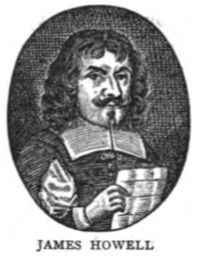
As a writer he was most voluminous, and embodied in his letters much interesting information gained from travel. His style was humorous and gossiping, and contained frequent allusion to facts elucidative of the history of the times. He was, perhaps, the first Englishman who made literature a means of livelihood. Wood, in his Athenæ Oxonienses, gives a list of fifty or more of his publications.
The antiquity of his family name was a matter of considerable interest to him, and in this connection he wrote, about 1654, to his cousin, Howell Gwyn, Esq., of Wales, thus:
“And now that I am upon British Observations, I will tell you something of this name Howell, which is your first and my second name; passing lately by the Cloysters of the Abbey at Westminster, I step’d up to the Library that Archbishop Williams erected there, and I lighted upon a French Historian, Bertrane a Argentre Lord of Forges, who was President of the Court of Parliament in Renes, the chief Town of little Britany in France, call’d Armorica, which is a pure Welsh word, and signifies a Country bordering upon the Sea, as that doth, and was first coloniz’d by the Britains of this Island, in the reign of Theodosius the Emperor, An. 387, whose Language they yet preserve in their radical words: In that Historian I found that there were four Kings of that Country of the name Howell, viz. Howell the first, Howell the second, Howell the Great (who bore up so stoutly against Aetius the famous Roman General) and Howell the Fourth, that were all Kings of Armorica, or the lesser Britany, which continued a Kingdom till the Year 874, at which time the Title was chang’d to a Duchy, but Sovereign of itself till it was reduced to the French Crown by Francis the first. There are many families of quality of that name to this day in France; and one of them desir’d to be acquainted with me by the mediation of Monsieur Augieur who was their Agent for England. Touching the Castle of good King Howell hard by you, and other ancient places of that name, you know them better than I, but the best Title which England hath to Wales is by that Castle, as a great Antiquary told me.”
After many vicissitudes, James Howell died at London in November, 1666, and was buried in the Temple Church. The inscription on his well-preserved monument in the Triforium gallery reads thus: “Jacobus Howell Cambro-Britannus, Regius Historiographus, (in Anglia primus) qui post varias peregrinationes, tandem naturae cursum peregit, satur annorum & famae, domi forisque huc usque erraticus, hic fixus 1666.” (James Howell, Cambro-Briton, the Royal Historiographer — the first in England — who, after various peregrinations by land and water, finally completed the usual course of nature, full of years and fame, thus far erratic at home and abroad, here fixed, 1666.)
His will, dated 8 October, 1666, proved 18 February, 1667–8, names brother Howell, sister Gwin, sister Roberta ap Price, children of brother Thomas, viz., Elizabeth wife of Jeffrey Banister, Arthur Howell, George Howell, also nephew Henry Howell. It is possible that Thomas Howell, of Gloucester county, New Jersey, was of this family.
Page 132
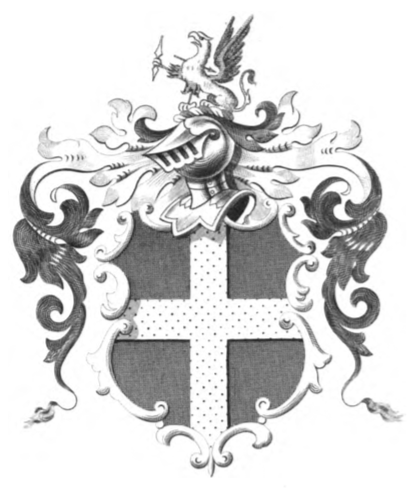
The Howells of Westbury, in Marsh Gibbon, county Bucks, descended from Howel, Prince of Caerleon-upon-Uske, in Monmouthshire, whose arms they bore — gules three towers, triple-towered, ar.
William Howell, of Wedon, in the parish of Waygate, gent, made his will 30 November, 1557, and named as devisees his wife Anne, and children John, Henry, Jacob, Isabell, Jane, Cecill, Agnes, Anne, Joane, and Alice; the poor of Wingrove, Hardwick, Wedon, Aylesbury, Whitechurch, and March.
A bill of complaint by John Howell, of Wedon, 1573, sets forth “that his father, also of Wedon, deceased, purchased the manor of Westbury in Marsh Gibbon, in the same county,” and that the same is now in the custody of his brother, Henry Howell.
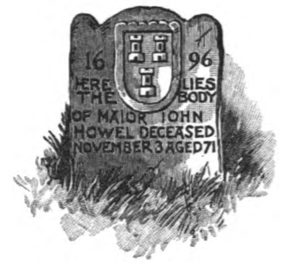
“Henry Howell, gent, was buried ye 7th day of July, 1625,” and at his death his son Edward Howell became possessed of the manor of Westbury, which, on 8 June, 1639, he, then “of Grewelltorpe, in the county of York, gent,” conveyed to Richard Francis, of Marsh Gibbon, for the consideration of sixteen hundred pounds. About this time Edward Howell emigrated with his family to America, locating first at Lynn, Massachusetts, where he held five hundred acres. He, however, removed to Southampton, Long Island, in 1640, of which he was one of the founders, and was a member of the governor’s council of Connecticut from 1647 until 1653. His son Major John Howel, prominent in the civil as well as in the military affairs of Long Island, was baptized at Marsh Gibbon, county Bucks, 20 November, 1624, and died at Southampton, 3 November, 1696.
Page 134
Footnote from Page 139#
Several of the Howell name emigrated to Pennsylvania about the time Thomas Howell arrived in New Jersey. Of these, John Howell, of Philadelphia, had numerous descendants, prominent among whom were Isaac Howell, one of the signers of the Continental bills of credit; Colonel Jacob S. Howell, clerk of the Pennsylvania board of war in 1776, and receiver-general of clothing of the Pennsylvania militia in 1778; Arthur Howell, an eminent Quaker preacher, who died in Philadelphia in 1816; and Colonel Joshua B. Howell, who commanded with distinction the eighty-fifth Pennsylvania volunteers in the late civil war, and fell in battle, 14 September, 1864, aged fifty-five years.
William Howell, of Castlebight, Wales, is another of the early Pennsylvania colonists. He is said to have come to the province with William Penn, and is claimed by one authority as the ancestor of Major Richard Howell, an officer in the Revolution, and governor of New Jersey from 1794 until 1801. Such claim would seem to be an error. William Howell makes no mention in his will of a son, and is believed not to have had male issue.
Major Richard Howell was a son of Ebenezer Howell by his wife Sarah Bond, and grandson of Reynold and Mary Howell, of Newark, Delaware. Reynold Howell purchased a plantation near Newark in 1724, and probably emigrated from Wales shortly before that date. He is one of the patentees named (1758) in the charter incorporating the town of Newark.
Dr. Lewis Howell, a brother of Major Howell, was a surgeon in the Revolutionary army, and died of fever on the day of the battle of Monmouth; and Richard Lewis Howell, a son of Major Howell, was captain in the United States army, and the father of Rear-Admiral John Cumming Howell, a distinguished officer in the United States navy. Lieutenant William Howell, another son, was the father of Varina, widow of Jefferson Davis, president of the Southern Confederacy.
For more information on Richard Howell’s family tree, click here for the WikiTree.com profile for Richard Howell.
Source#
Genealogical and Biographical Memorials of the Reading, Howell, Yerkes, Watts, Latham, and Elkins Families
Published 1898. Digitized by Google from the library of the University of Wisconsin – Madison and uploaded to the Internet Archive.
Publisher: Lippincott
URL: https://archive.org/details/genealogicaland00leacgoog